

To Cross Is Also to Belong
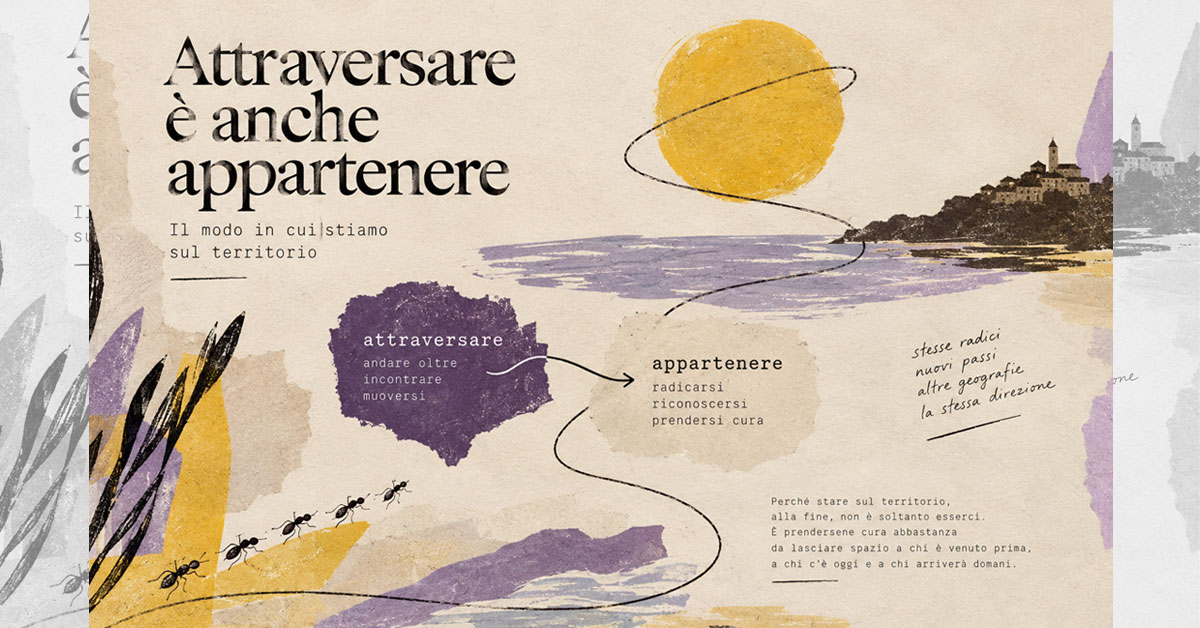
The way we inhabit the place we live in
There are words that seem to describe two opposite movements.
To cross means to go beyond, to move from one place to another, to set oneself in motion.
Belonging, on the other hand, seems to ask us to stop: to have roots, to recognise ourselves in a place, to feel that, in some way, it is ours.
And yet, for those who live among multiple histories, languages and memories, perhaps the two are not so far apart.
For the Dizionario della Parità, we proposed precisely these two words.
We did not yet know that they would also become a good way to tell the story of these past months.
What have we been doing?
We could answer with a list.
We crossed places, met people, listened to stories, took part in initiatives and learned new things.
But lists, as we know, tell us very little.
What interests us more is how we chose to be present.
We moved through the summer starting also from a memory that belongs to us: Ecuador, as we celebrated 217 years of independence. A moment that took us back to our origins, to the stories that travel with us and to that subtle thread that continues to connect a distant place with the one where we live today.
Then we came together at TimbuFest, among bodies, memories, sounds and stories.
And, along the way, we encountered other women, other organisations, other stories. Sometimes by speaking up, sometimes by sharing our skills, and sometimes simply by listening.
Because words, too, are territory.
We experienced this while working on the Dizionario della Parità, choosing attraversare and appartenenza. Two words that seemed to point in different directions, but that ultimately came together in the very way we were living these months.
We also learned.
The training with the Centro per le Pari Opportunità gave us tools to continue questioning the way we talk about equality, the words we choose and those that, sometimes, need to be reconsidered.
And as we write, from 21 to 24 September, we have been taking part in another learning experience with Con Valores Hub – Incubadora, during Founders Week.
Another space in which to learn, exchange ideas, gather tools and open up possibilities.
In the meantime, we have been working like little ants.
Without making too much noise.
Building relationships, looking for opportunities to learn, bringing together tools for what is yet to come.
Perhaps this, too, is a way of inhabiting the place we live in.
Not everything we do needs to be told immediately. Some things need time. Others still need to find their form.
And so we are also learning the art of erasure: not to hide, but to allow what matters to emerge.
Not to be everywhere.
Not to say everything.
Not to occupy every space.
Choosing where to be present, how to be present and, sometimes, when to take a step back.
Because participation is not a competition to see who can be seen the most.
It is a responsibility towards the space we share.
Events end. Days pass. Photographs remain for a while.
But something continues.
The words we encountered remain, the relationships we built remain, the questions we carried home with us remain.
The traces of those who came before us remain, as do those that, perhaps, we will leave for those who come after us.
Care, perhaps, is also this: not allowing what we have received to end with us.
For us, crossing and belonging are therefore no longer two words in opposition.
We can cross a place and, in crossing it, learn to feel part of something.
We can belong without ceasing to move.
We can come from far away and contribute to building the place where we live today.
And perhaps this is precisely where our way of inhabiting the place we live in begins.
Not from the need to always be present, but from the responsibility to be there when our presence can...
add a voice,
open up a space,
create a relationship.
Because inhabiting a place, in the end, is not simply about being there.
It means caring for it enough to leave space for those who came before, those who are here today and those who will come
tomorrow.