

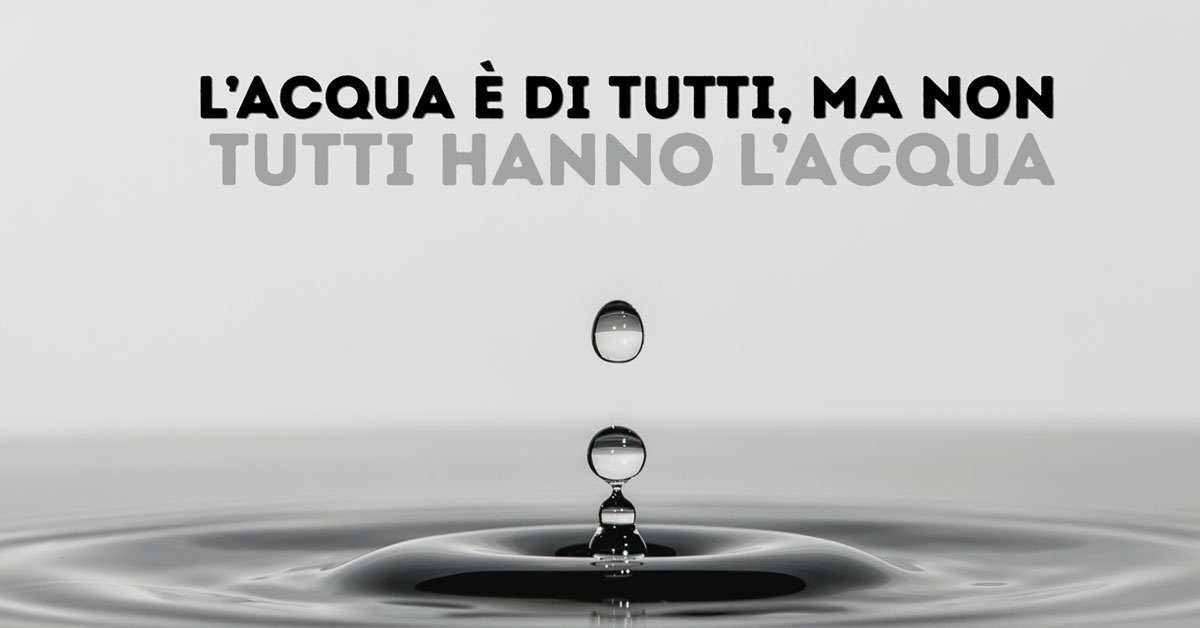
Water Belongs to Everyone, but Not Everyone Has Water
A glass of water.
We pick it up without thinking.
We turn on the tap, fill the glass, drink.
It is one of the simplest gestures of our day. And precisely because it is so simple, it is easy to forget that inside that glass there is a piece of the world: a spring, an aquifer, a river, a mountain. There are pipes, infrastructure, energy. And there are decisions.
Because water reaches our glass through a long chain of possibilities. And not everyone has the same possibilities.
Water belongs to everyone, but not everyone has water.
A flower
Think of a flower.
One of those perfect flowers we see in shops, brought in from far away.
We look at it and we see a flower.
We do not see the water.
In different regions of the world, large-scale crops destined for international markets are grown in areas where water is a fragile resource.
But when drought comes, not everyone has the same ability to cope with it.
River water can be diverted.
Aquifers can be exploited.
Crops can continue to grow.
And meanwhile, for some people, that same water becomes harder to find.
There is no need to decide who is right and who is wrong.
We only need to look at the two images.
On one side, a flower that leaves.
On the other, a land with less and less water.
The flower travels, the thirst remains.
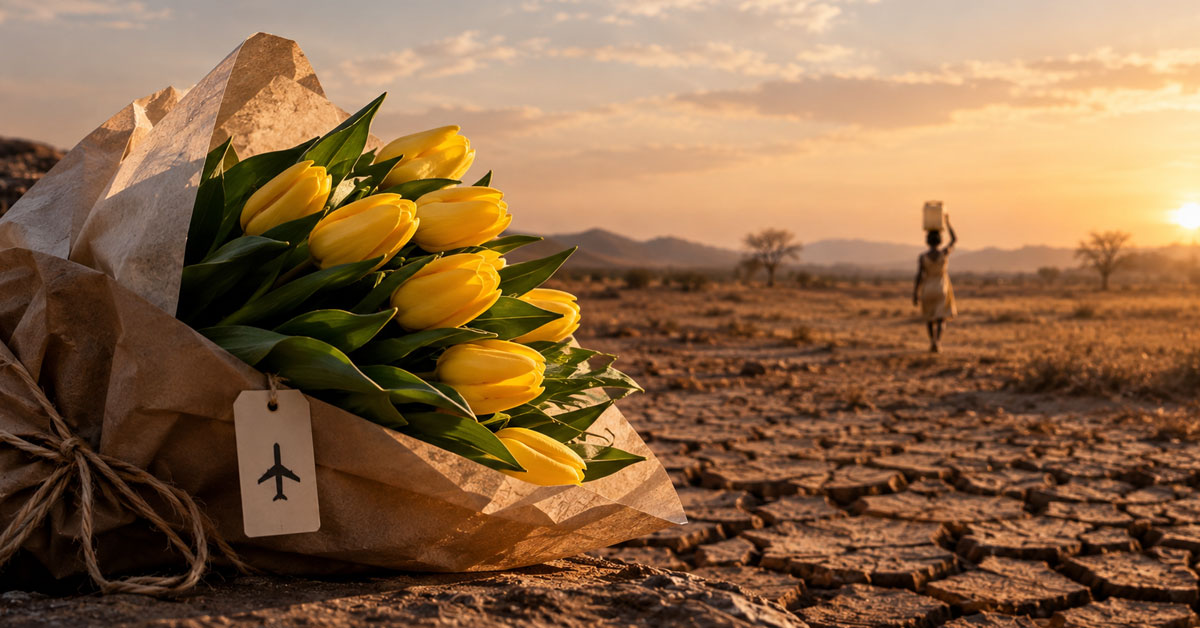
The flower crosses a continent; the thirst perhaps does not.
And perhaps this is what we do not see when we look at a flower: not only how much water is part of its story, but how much that story depends on the land that allowed it to grow.
A small image of how a natural resource can enter a global chain without us ever seeing the journey it has taken.
An oasis in the desert
Now let us look at an oasis.
But not all oases come into being in the same way.
Some preserve a fragile balance, built over time between land, water and communities.
And then there are contemporary oases.
Some of the great cities built in the desert have created gardens, lawns, swimming pools, artificial lakes and fountains.
Water becomes landscape, architecture, spectacle.
It is a particular form of abundance: water in the desert not only as a necessity, but as a possibility.
It is an image that makes us think.
Because within the same broad geographical space, there are people for whom water is still a distance to be travelled, a resource to be rationed, an uncertain presence.
And so that fountain tells us something.
Not necessarily how much we waste.
It tells us how much we can afford.
Perhaps this is precisely where water becomes political: not only when it is scarce, but also when it can become a spectacle.
When there is no longer enough water
For a long time, we thought of the water crisis as something that would happen in the future.
A problem for the next generations.
But something has already changed.
In 2026, the United Nations University spoke of “water bankruptcy”: freshwater systems being used beyond their capacity to regenerate, with aquifers being depleted, ecosystems deteriorating and natural reserves coming under ever greater pressure.
It is a powerful term.
Bankruptcy.
As if water, too, could reach a point where the numbers no longer add up.
And in the meantime, very different people are paying the price.
Today, around 2.1 billion people still lack access to safely managed drinking water.
This is not only a question of the future.
It is a question of the present.
And what about the water that never arrives?
Let us go back home and turn on a tap. Because even here, where water is available, something does not add up.
In Italy, in 2022, 42.4% of the water entering municipal distribution networks was lost.
Water already collected.
Water already treated.
Water already in the network.
Water that never reached the glass.
That is around 3.4 billion cubic metres.
According to ISTAT, the water lost through municipal networks could have met the water needs of approximately 43.4 million people for an entire year.
So the question changes.
When we say there is not enough water, how much water is actually missing?
And how much, instead, do we lose along the way?
The water we do not see
Then there is all the water we never see.
The water that goes into wheat.
Into tomatoes.
Into flowers.
Into livestock farming.
Into products that travel around the world.
Agriculture is the largest user of freshwater globally: around 70% of withdrawals are used by this sector.
This is why talking about water also means talking about what we produce, where we produce it and how we produce it.
It means talking about trade.
About energy.
About consumption.
About territories.
And it means remembering that the price of a product does not necessarily tell us everything it cost to produce.
Especially when one of those costs is something we cannot see.
Water.
Berta
At this point, we can look at a river with different eyes.
And we can meet Berta Cáceres.
Her story is connected to the Gualcarque River and to the defence of the territory of the Lenca community in Honduras.
For Berta, that river was not simply a resource.
It was territory.
It was life.
It was community.
It was a way of inhabiting the world.
Her voice reminds us that behind words such as development, energy, infrastructure and resources, there are always territories and people.
And that a river can be many things.
It can generate energy.
It can irrigate a field.
It can supply a city.
It can become part of an economic project.
But it can also be a place worth defending.
Open your eyes
Vanessa Nakate brings us another image.
Open your eyes.
Looking at the climate crisis also means looking at where its burden falls.
Not only at temperature.
But at water.
Land.
Food.
The possibility of staying.
The possibility of living in a place without having to leave it.
The climate crisis does not send everyone the same bill.
For some, it is a forecast.
For others, it is already everyday life.
And climate change makes a resource on which everything depends even more unstable.
Water.
A question of time
When water does not reach the home, someone has to go and collect it.
In many parts of the world, it is mainly women and girls who are responsible for collecting water.
It is not only a question of water.
It is a question of time.
Hours of walking.
Waiting.
Weight.
Time taken away from school, work and rest.
This is why water is not only a natural resource.
It is also a resource of time.
And time, like water, is not distributed equally.
The vote
Fifteen years ago, we voted in Italy.
It was the 2011 referendum.
The required turnout was reached and, on the two questions concerning the management of local public services and water service tariffs, the Yes vote exceeded 95% of valid votes.
That vote said something.
It said that, for a very large part of the country, water could not be considered just another commodity.
A common good.
A collective responsibility.
A right.
Indeed, the right to safe drinking water and sanitation had already been recognised by the United Nations General Assembly in 2010 as a human right essential to life and to the full enjoyment of all other human rights.
Fifteen years have passed, the climate has changed, pressure on water resources has increased, and we continue to debate infrastructure, management, investment, agriculture and consumption.
Perhaps that question is still there:
who decides about water?
Back to the glass
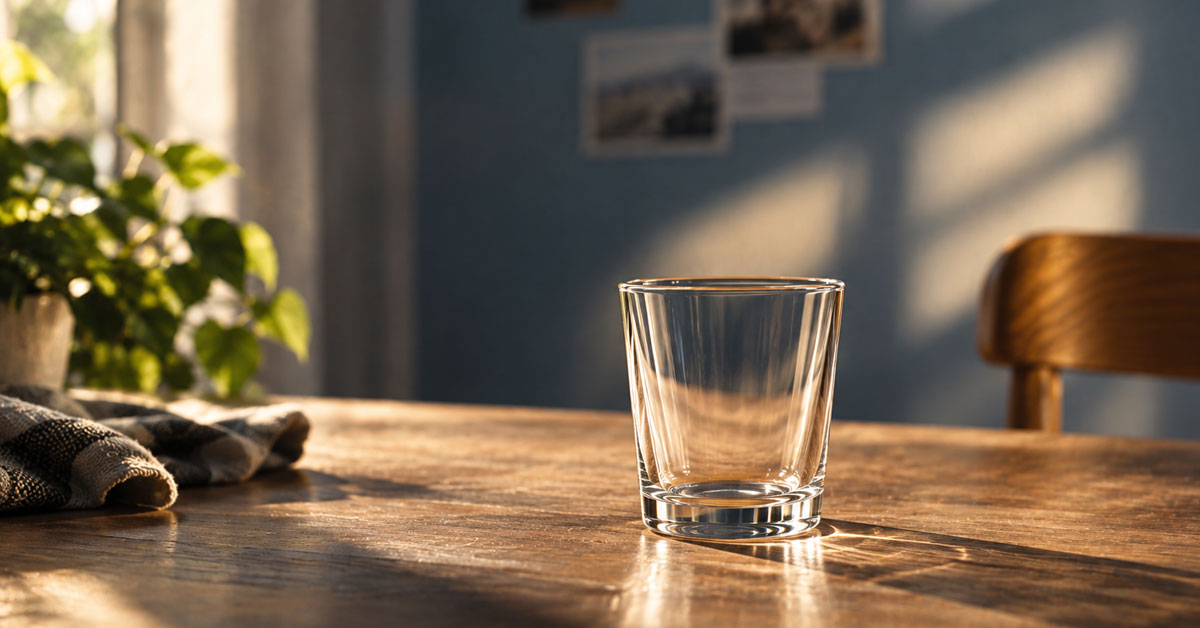
The glass is still on the table.
Only now it no longer seems quite so simple.
Inside that glass there is a mountain.
There is an aquifer.
There is a river.
There is a field.
There is a network.
There is energy.
There is a supply chain.
There is a decision.
And perhaps there is also a part of the world we cannot see.
This is why talking about water does not simply mean asking how much of it we consume.
It also means asking who has access to it, who governs it, who decides how it is used and which territories bear the cost of our choices.
Because water belongs to everyone.
But not everyone has water.
And the cost of a glass of water
is not measured in money alone.