


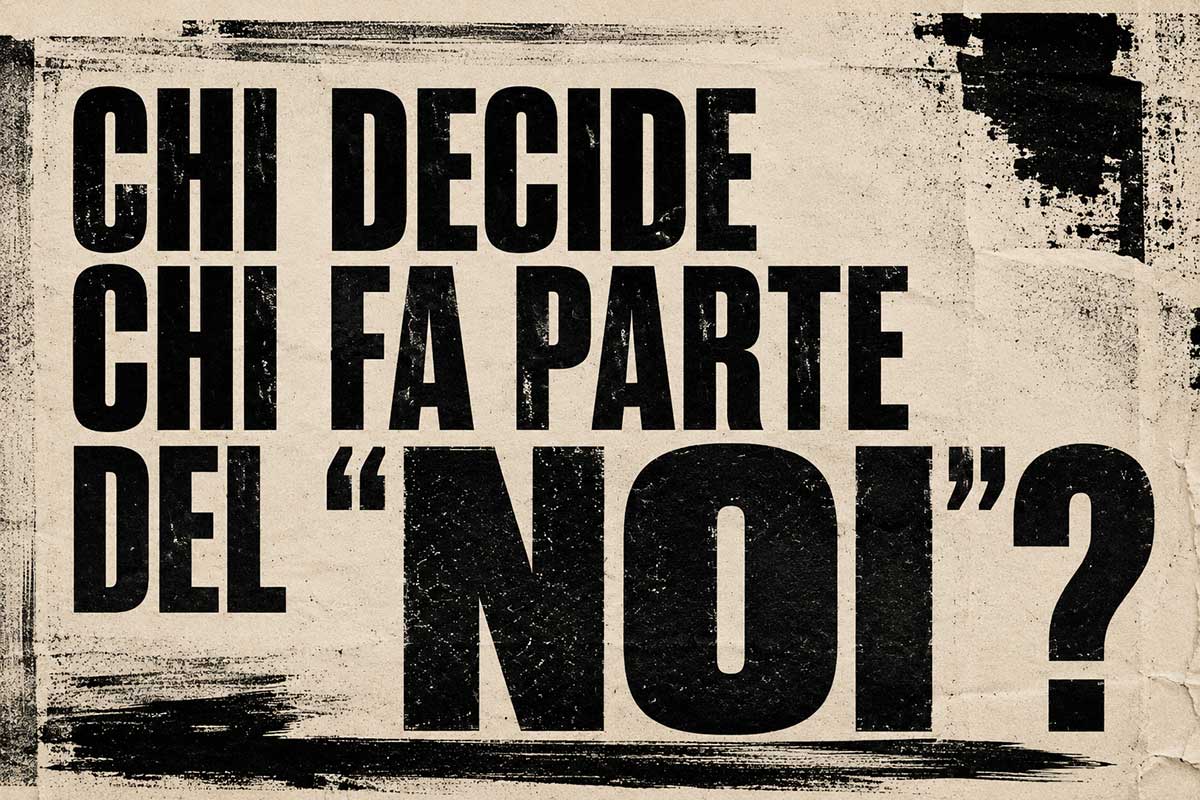
Who Decides Who Belongs to "Us"?
Every society creates a sense of "us."
A group of people who are recognised as part of the community, of a shared history, of the collective imagination.
But that "us" is never neutral. It expands, contracts and is continually redefined over time. And it often tells us more about those who draw its boundaries than about those who remain outside them.
Every year, on 19 June, the United States celebrates Juneteenth, the day commemorating the end of slavery. It may seem like a story that belongs to another continent and another era. Yet that date continues to raise a surprisingly relevant question: what happens when a person gains freedom but still has to prove that they belong to the very community they are already part of? History teaches us that freedom is a fundamental achievement, but not always a sufficient one. Between the recognition of a right and the recognition of a person there is often a distance that spans generations.
The writer Toni Morrison expressed this with remarkable clarity: becoming free is one thing; claiming ownership of that freed self is another. In other words, freedom does not automatically lead to belonging.
This reflection is not limited to African American history.
It speaks to every plural society.
It speaks to us as well.
For many people living within diasporas, the question of belonging is not a theoretical exercise. It is an everyday experience. It means studying, working, participating in public life, building relationships and contributing to society while, despite all this, sometimes feeling required to prove what is automatically recognised in others.
The point is not to question differences. Differences exist, and they are part of the richness of our societies. The question is another: who decides when someone stops being perceived as a guest and begins to be recognised as part of "us"?
The answers are not found only in laws or institutions. They are built through language, public narratives, opportunities that are offered or denied, and the expectations we project onto others. They are built every time we define who belongs and who is still expected to prove something.
And yet the stories of diasporas tell us something more.
They tell of people who continue to invest in the future, often knowing that the deepest results of their commitment may be reaped by those who come after them. They tell of mothers, workers, students, activists and professionals who create spaces for participation not only for themselves, but also to make those paths more accessible to future generations.
In this sense, Juneteenth is not only a remembrance of the past. It is also a reflection on the future.
It reminds us that freedom is not a final destination. It is a condition that must continually be made real through mutual recognition, participation and the widening of spaces for citizenship.
Because perhaps the question is not who belongs to "us."
Perhaps the real question is how willing we are to widen that "us" without continually asking someone to prove they deserve it.