


Coffee with the Feminists
Imaginary conversations about power, empowerment and the women we still haven’t learned to listen to.
But are we really sure that empowerment is always good news?
Imagine an ordinary morning.
Naples.
Any café will do. The kind where coffee arrives quickly, the chairs are never quite where they are supposed to be, and by nine o’clock someone is already passionately arguing about something we know nothing about.
Let’s say Naples, because some conversations need good coffee.
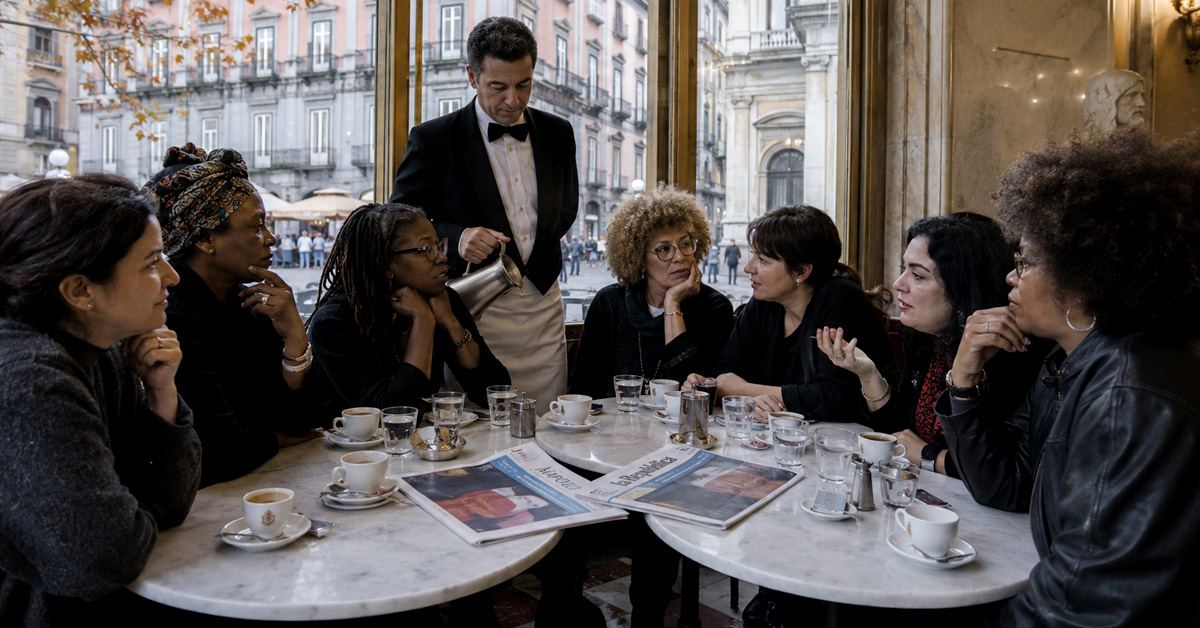
A group of women are sitting around a table.
Not statues. Not icons.
Women.
Carla Lonzi, Audre Lorde, bell hooks, Angela Davis, Michela Murgia, Marjane Satrapi.
Yes, we know: they could never all be there together.
That’s precisely the beauty of it.
For one morning, let’s suspend the calendar, geography and, to some extent, reason itself.
We don’t want to build the usual pantheon of quotations.
We want to let them talk to one another.
Like what happens in families when women from different generations gather around a table and, sooner or later, start talking about the younger women in the family.
“In our day…”
“Yes, but today…”
“No, wait. You haven’t understood this.”
And they probably wouldn’t agree on many things.
All the better.
One takes her coffee without sugar.
One has already started arguing.
One listens.
Then comes the question.
“But are we really sure that empowerment is always good news?”
Silence.
Because empowerment is a word we like.
It speaks of autonomy, awareness, agency, freedom, access.
All wonderful things.
But access to what?
And above all: to what kind of power?
We have been taught that an emancipated woman is one who makes it.
Who succeeds.
Who gets in.
Who takes up space.
Who finally gets a seat at the table.
And of course, getting there matters.
But perhaps it isn’t enough.
Because once she enters the room, that woman may discover that she has a very particular problem.
She begins to wonder whether she really deserves to be there.
There it is.
Impostor syndrome.
An almost elegant name for a feeling that far too many women know all too well.
But let’s go back to the room.
Because perhaps the problem is not only who manages to enter it.
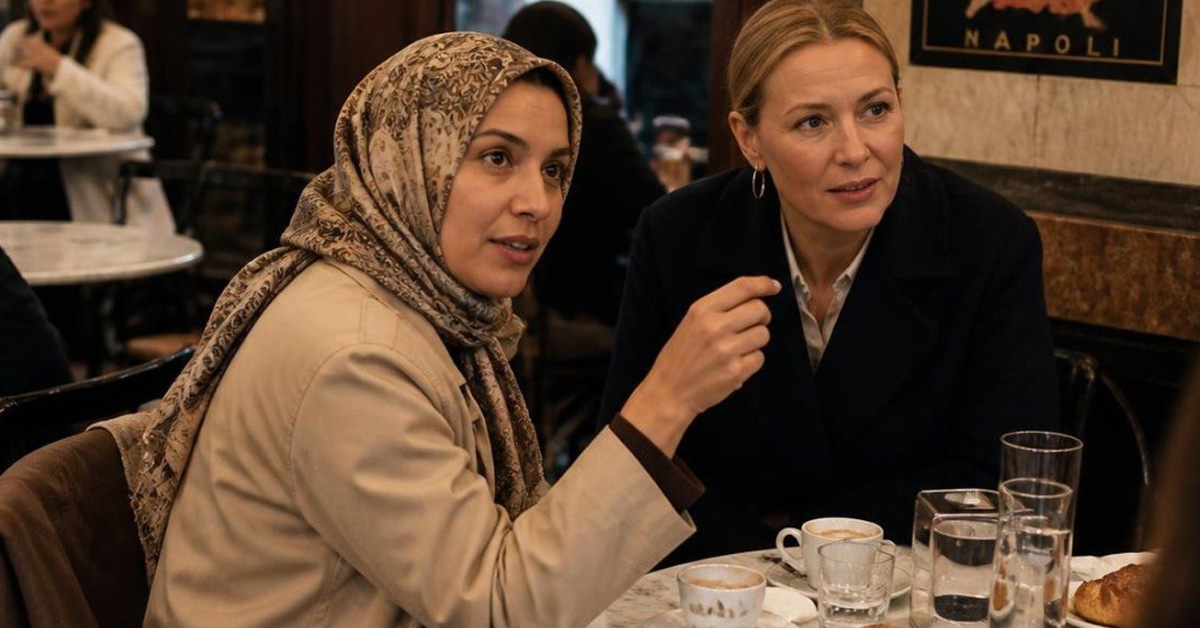
At some point, a woman who has been listening until now might say:
“Excuse me, but can I ask you something?
You’re talking about how to bring more women into the room.
But have you looked at who builds the room?”
And there we have it.
The room is not just a room.
It is an institution.
It is a boardroom.
It is a political party.
It is a university.
It is a newsroom.
It is a city.
It is a network of relationships, rules, languages and hierarchies that determines who gets to speak, who is listened to, who is believed, who is promoted, who is invited.
The door, then, is not just a door.
It is the time you have.
Your connections.
The place where you were born.
The possibility of moving from one place to another.
The possibility of being considered competent before having to prove it three times over.
Because even the time needed to read, study, learn, participate, meet other people, visit a museum or simply be present depends on concrete conditions that make it possible.
So perhaps the question is not only:
“How do we get more women into the room?”
But:
“Who decided what that room should look like?”
And further:
“Who decided that this was the room we were supposed to want to enter?”
There is no such thing as an abstract woman
This is where intersectionality stops being a word for conferences.
It becomes a way of looking carefully and critically.
Because there is no such thing as an abstract woman.
There are women shaped by different histories, circumstances, experiences and positions.
And those differences do not remain outside the room.
They enter with us.
Sometimes they open doors.
Sometimes they close them.
Sometimes they mean that the same words, spoken by one woman, are considered authoritative and, spoken by another, are considered aggressive.
Sometimes one woman is invited to speak.
Another is invited to share her experience.
They may sound like the same thing.
They are not.
The room and those who build it
And this is where a non-Western feminist genealogy becomes indispensable.
Because it reminds us that feminism is not born only in universities, books and grand speeches.
It is born in workplaces, homes, neighbourhoods and collective struggles.
Among women who were not waiting to be invited into the room.
The room has not always been there.
Someone built it.
And before that, someone else had to convince the world that those women had the right to enter it.
The women who were not in the picture
And then there were those who were often left out of the picture: housewives. Yes, them.
Women who may never have uttered a slogan, held an academic chair or appeared in a photograph.
But they held pieces of life together while other women were able to leave the house, study, work, meet and organise.
They raised children, looked after other women’s children, prepared dinners and stretched household budgets so that others could travel and take part.
They listened.
They waited.
And this too was political work, even when no one called it that.
Without that invisible work, much of the participation we celebrate today would not have been possible.
Perhaps it is time to broaden our pantheon too.
Because some women built the room.
Others made it possible for other women to reach it.
And then come the pick-me girls
At this point someone might say: fine, then the pick-me girl is simply the woman of patriarchy.
Yes.
And no.
That is only half the truth.
Because that woman has often worked hard to win patriarchy’s approval.
She has learned the rules.
She has understood what gets rewarded.
She has understood how to become the reassuring exception.
She does not necessarily want to change the room.
She wants to be the woman that room is willing to accept.
And that is an enormous difference.
Because it reminds us that patriarchy does not function simply because men are in charge.
It also functions because some of its rules become desirable, convenient, even rewarding.
There is no need to condemn the woman.
We need to understand the system of rewards that taught her how to play that game.
Then the girls arrive
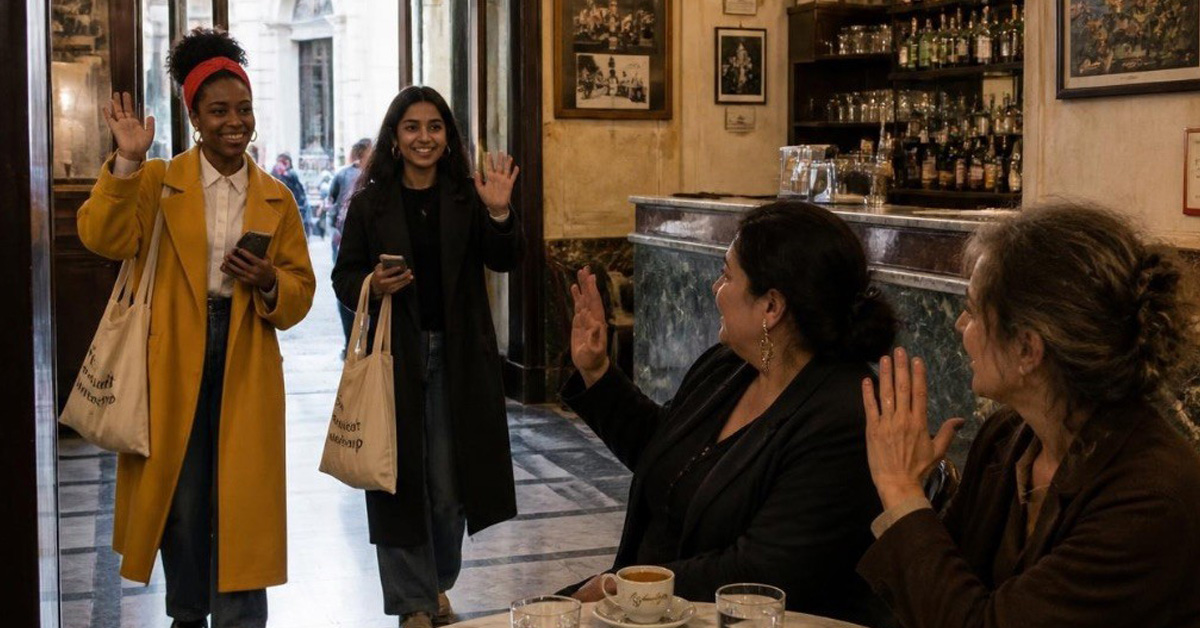
The café door opens.
One young woman walks in.
Then another.
They don’t carry themselves like our historic feminists.
They have phones in their hands.
A campaign already open on the screen.
A video to post.
A petition.
A hashtag.
A protest organised through Instagram.
And suddenly we realise that the room has changed.
This is Generation Z.
Their feminism has no single centre.
It does not live only in books, universities, political parties or traditional organisations.
It moves online.
It travels through social media.
It organises around climate, civil rights, gender equity, racial and social justice.
It is intersectional.
It is digital.
It is global.
And it is often much faster than we are.
Among them is Amika George, who helped bring period poverty into the public and political sphere, transforming an issue long treated as private and embarrassing into one of inequality, access and rights.
And then she arrives.
Yellow coat.
A headband over her red braids.
A determined gaze.
Amanda Gorman.
She hardly needs an introduction.
She sits down.
She listens.
And she seems to know already that sooner or later it will be her turn to speak.
The young women of Gen Z are showing us something worth observing without paternalism.
They have changed the tools.
Not necessarily the questions.
They still want justice.
Still freedom.
Still rights.
Still possibilities.
But they have created new ways for their words to circulate.
A phone can become a public square.
A video can become a campaign.
An image can become a political statement.
A personal story can become a political issue.
And yes, social media sometimes produces superficiality, oversimplification, battles over positions and an industrial quantity of unsolicited opinions.
Welcome to the world.
Our generations were not exactly immune either.
The difference is that they have turned that noise into one of the tools of their mobilisation.
And perhaps this is precisely where we should stop saying, just for a moment:
“In our day…”
and listen.
Because every feminist generation inherits something.
And invents something of its own.
No one gets there alone
Perhaps this is what empowerment, on its own, cannot tell us.
A woman can reach the top.
She can earn a position.
She can become visible.
She can have a voice.
But the point is not only how high she rises.
It is what she does once she gets there.
Whom she names.
Whom she listens to.
Whom she helps to grow.
Whom she brings with her.
Whom she lets in.
And above all: if we reach the top and leave the ladder exactly as it is, have we really changed anything?
Perhaps feminism is not a competition to occupy the best seat.
Perhaps it is the ongoing, unfinished attempt to understand why there is only one seat.
And to decide what to do with it.
Meanwhile, the conversation at our table continues.
We do not know exactly what those women would say. We can only imagine their exchange, starting from the questions their work, their struggles and their lives have left open.
Carla Lonzi.
Audre Lorde.
bell hooks.
Angela Davis.
Michela Murgia.
Marjane Satrapi.
And, a little further along the table, the young women who have just arrived.
Not a pantheon.
A conversation.
Because feminism is not a catechism.
We do not need to find a definitive statement.
We need to keep bringing different experiences, conflicts, generations and places into conversation.
And this is also why networks of diaspora women have something to say.
Not because they represent all women.
But because they remind us that no woman ever enters a room alone.
She carries a history with her.
A language.
A memory.
A migration.
A job.
A loss.
A possibility.
And perhaps someone else’s name too.
Some time ago, there were about fifteen of us women in a room.
At one point we looked at one another and smiled at the variety of our lives.
Women with different journeys, different relationships, different identities, different choices.
And yet, there.
Together.
Not the same.
Not interchangeable.
In relation to one another.
Perhaps this is precisely what we are still learning.
We do not need to be all the same to stand on the same side.
We need to know who is still missing from the room.
And to realise, when she finally arrives, that perhaps she does not just want a chair.
Perhaps she wants to change the table.
Perhaps she wants to open a window.
Perhaps she wants to build another room.
Or perhaps she simply wants to tell us:
“Good. Now let’s talk about who isn’t here.”
The coffee is finished.
Someone checks the time.
Someone pays.
Someone stays for another five minutes.
And outside, Naples continues to do what cities do: move, change, contradict itself.
We get up.
The chair remains.
But it is no longer empty.
Because we have finally understood that the point is not to fill every chair.
It is to decide together who gets to build the room.
And perhaps, today, this is how feminism moves forward: from those who built the room to those who keep changing it.