


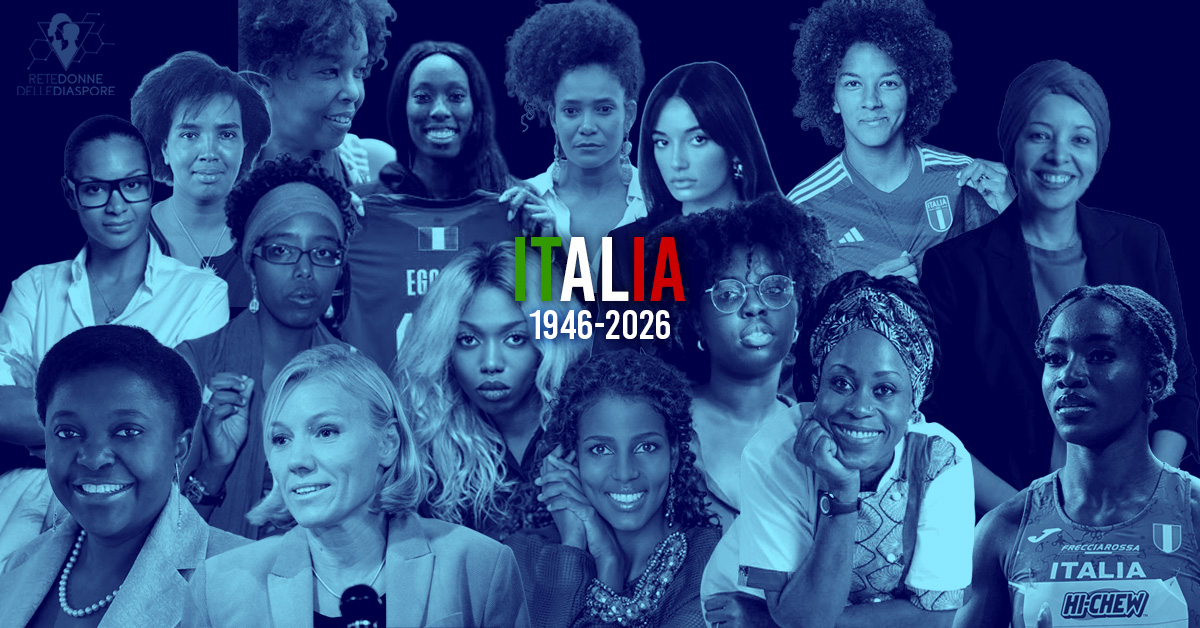
The Women of the Republic yet to be named. A portrait of today’s Italy, 80 years after the birth of the Republic
The ANSA exhibition Le donne della Repubblica tells eighty years of Italian history through images and female figures who have shaped the political, institutional, cultural and social life of the country.
It is an important narrative. But every narrative, by its very nature, is also a choice.
This article is not intended to correct that exhibition, nor to compile an alternative list. Rather, it begins with a question: what is the face of Italy today, eighty years after the birth of the Republic?
As the movement behind our network has long reminded us, making people visible is already a form of transformation. For this reason, some figures who also appear in the exhibition, such as Paola Egonu and Josefa Idem, find a place in these pages as well. Not to repeat a list, but to reaffirm a simple principle: what is named enters collective memory; what remains unnamed is more likely to disappear from the public narrative.
In Italian public discourse, expressions such as “new Italians” or “second generations” are often used. Yet many of the people described in this way were born here, grew up here, or have built their professional and civic lives here. For this reason, the expression “people with migrant backgrounds” is increasingly used: not an identity, but a story.
Looking at these women means looking at a part of contemporary Italy that already exists, but does not always appear when the country tells its own story.
Within institutions, figures such as Cécile Kyenge have marked an important chapter in the history of the Republic. A physician, minister and Member of the European Parliament, Kyenge has represented a full and active presence within both Italian and European institutions. Before her, Dacia Valent became the first Black woman elected to the European Parliament for Italy, a figure now too rarely remembered despite her significance in the history of political representation. More recently, Marwa Mahmoud embodies a generation that is not entering citizenship: it is already practising it every day through public engagement.
Sport also reflects part of the country's transformation. Paola Egonu is one of Italy’s most internationally recognised athletes and one of the strongest images of contemporary Italy. Sara Gama has helped redefine leadership in women’s sport, while Zeinab Dosso represents a new generation of Italian athletics. Josefa Idem, meanwhile, tells a story of belonging built through sport and public service.
There are also women who have reshaped the collective imagination. Denny Méndez was not simply a pageant winner: she represented one of the moments when the country questioned who could embody the very idea of being Italian.
Others have transformed the way Italy tells its own story through culture. Igiaba Scego has worked for years on colonial memory and multiple identities. Alongside her, Espérance Hakuzwimana, Djarah Kan and Kaha Mohamed Aden are expanding the landscape of contemporary Italian literature, bringing to the centre experiences that for a long time remained at its margins.
The same transformation can be seen in the world of creativity. Stella Jean has built one of the most original experiences in contemporary Italian fashion, combining craftsmanship and multiculturalism.
Amina Muaddi represents a global creative generation, able to move between Italy and the wider world without contradictions of belonging.
In music, Mariam Battistelli brings Italian talent to the international opera scene, reminding us that cultural excellence takes many forms.
In haute cuisine, Victoire Gouloubi is helping redefine the face of a sector that lies at the heart of Italy’s cultural identity.
These women are not outside the Republic.
They are within it.
They are present in institutions, sport, culture, fashion, music and the creative industries. They are part of Italy’s present.
Perhaps the point is not to add new names to an existing list.
Perhaps the point is to widen our gaze.
Because, eighty years after the birth of the Republic, telling the stories of these women simply means looking at reality as it is.
Looking at what Italy looks like today.